
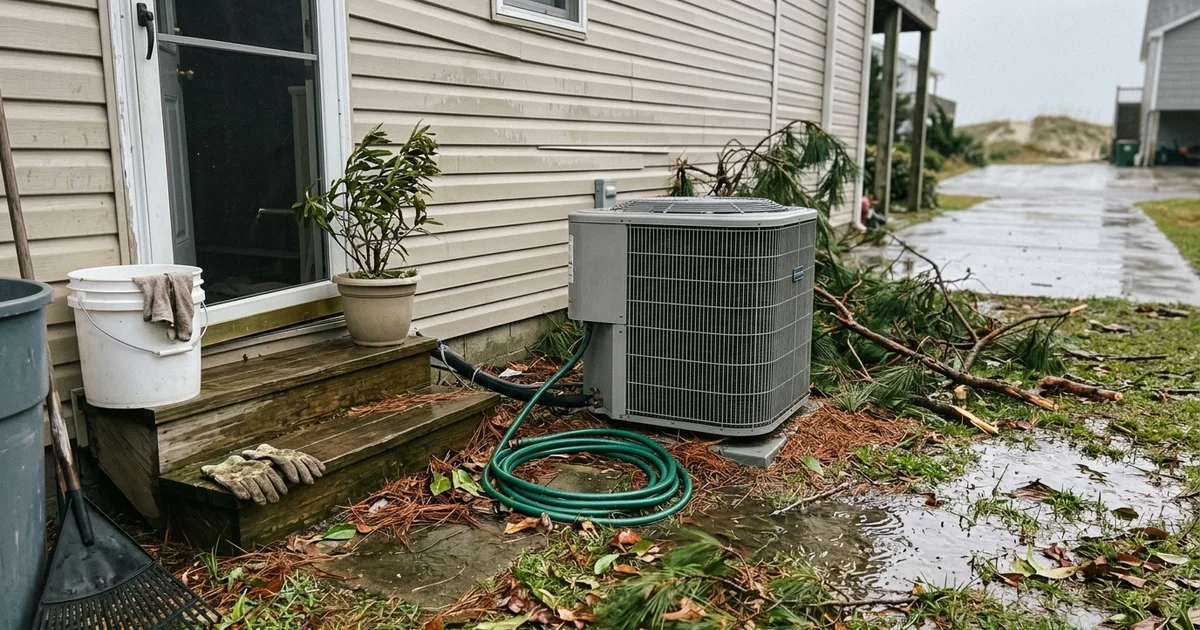
We know the drill when heavy summer skies roll in over Mobile Bay. Afternoon thunderstorms hit the Eastern Shore constantly, bringing an average of 44 storm days a year. Our network gets flooded with questions about an ac not working after power outage events.
The reason is that power rarely comes back cleanly. We often see voltage spikes that easily fry sensitive air conditioning components. If your system refuses to start, our emergency AC repair line is answered 24/7.
We are going to break down why this happens and what steps you can take right now.
This guide covers the essential steps:
- Performing a safe restart method.
- Identifying physical surge damage.
- Dealing with insurance claims.
Why Outages Hit ACs So Hard
Outages destroy air conditioners because power restoration creates massive electrical surges. We know that these surges easily overwhelm the sensitive circuitry inside the equipment. A standard residential circuit runs at 240 volts, but a restoration spike can deliver thousands of excess volts.
Our service area along the Eastern Shore sees these voltage spikes frequently from June through November. The air conditioning compressor is the largest motor in a house and cannot handle that kind of unstable electricity. We always advise homeowners that these extreme fluctuations quickly burn out control boards or melt wiring.
This is exactly why an ac not working after storm conditions is such a common issue here. We recommend keeping an eye out for these specific power anomalies:
- Voltage spikes: A sudden, massive increase in electricity.
- Brownouts: A dangerous drop in voltage that starves the motor.
- Flickers: Rapid on-and-off cycling that stresses the compressor.
The Safe Restart Sequence
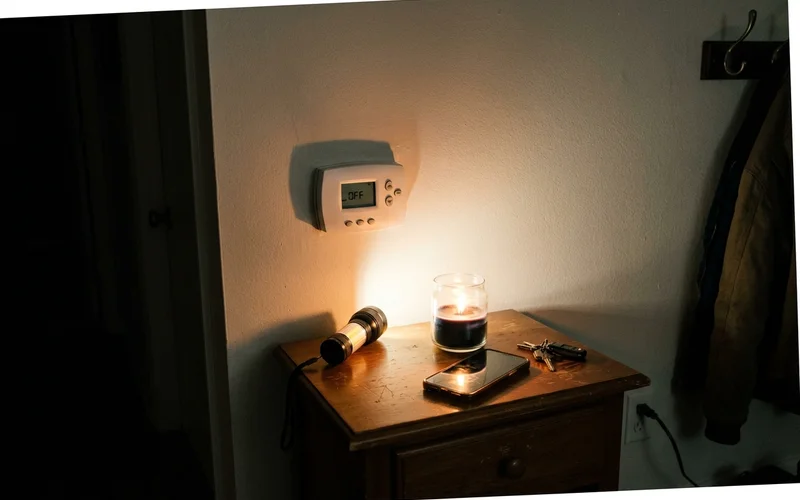
The best way to restart your system is to completely disconnect it from the thermostat and wait for stable electricity. Following a specific resetting sequence resolves a large portion of post-outage problems. Most modern thermostats include a built-in time delay relay that lasts three to five minutes.
Our advice is to be patient during this phase because it allows internal refrigerant pressures to safely equalize. Trying to bypass this delay can cause the compressor to stall and trip the breaker. We suggest trying this sequence before picking up the phone.
- Set the thermostat to Off as soon as the power goes out.
- Wait until power has been stable for 15 to 30 minutes. Flickers and repeat outages are common right after restoration.
- Check both AC breakers. Reset a tripped one once.
- Check the outdoor disconnect is fully in the On position.
- Set the thermostat back to Cool. Give the system 3 to 5 minutes to start.
- Listen and feel. Within 10 minutes the outdoor fan should spin and warm air should blow up from the top.
Signs of Surge Damage
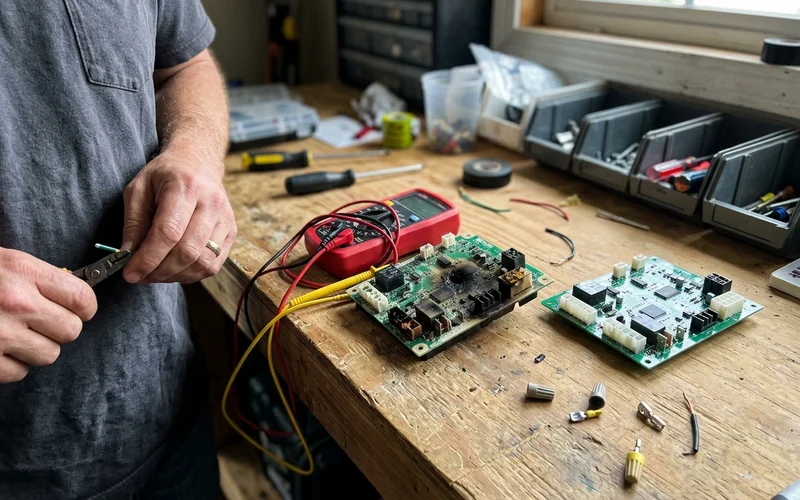
Surge damage usually leaves clear physical or electrical clues, like a humming unit or a completely dead system. We often see that replacing a blown component is necessary when the restart sequence fails. The average cost to replace an air conditioning compressor can range from $1,200 to $2,500.
Our recommendation is to identify the exact symptoms early to prevent further destruction. Some electrical issues will continue to generate heat and create fire hazards if left alone. We put together a list of the most common red flags.
- Humming outdoor unit with the fan not spinning. This is usually a blown capacitor. You can learn more in our guide to capacitor problems.
- Totally dead system with power at the breaker. This is often a blown low-voltage fuse, a dead transformer, or a fried control board.
- Outdoor unit dead, indoor fan running. This indicates a failed contactor or capacitor.
- Breaker trips immediately. This points to a shorted component. Stop resetting it immediately.
- Burning smell. Turn everything off at the breaker right away and call for help.
Flooded Outdoor Units: Do Not Run
Flooded outdoor units must remain turned off to prevent catastrophic electrical shorts and severe shock hazards. We strongly advise leaving the breaker off until a licensed contractor inspects the equipment. The Federal Emergency Management Agency advises that water in motors, wiring, and controls will completely destroy the compressor if you run it.
Our local contractors see extensive damage from saltwater storm surges because the salt keeps corroding the metal long after it dries. This process is known as galvanic corrosion, and it acts very quickly on aluminum fins and copper coils. We suggest following strict safety protocols regarding standing water.
| After the storm | What to do |
|---|---|
| Power restored, no visible damage | Follow the safe restart sequence exactly. |
| Branches or debris on the unit | Power off, clear by hand, inspect fins carefully, then restart. |
| Unit tilted off its pad | Leave off, call a contractor (refrigerant lines may be severely stressed). |
| Unit sat in water | Leave off at the breaker, call for an immediate professional inspection. |
| Restart fails | Call for service, as this is likely ac surge damage. |
Protecting the System Next Time
The most effective way to prevent future damage is by having a whole-system HVAC surge protector installed at the outdoor disconnect. Type 2 surge protectors are designed to absorb massive voltage spikes before they reach the equipment. A quality protector will sacrifice itself to save a $2,000 compressor.
Our best tip is to turn the thermostat off manually the moment an outage begins. This simple action disconnects the control board from the incoming power line entirely. We cover more ways to secure the unit in our guide to hurricane season AC prep.
Proactive homeowners can take a few extra steps before the next storm hits. Our top recommendations include:
- Elevating the unit: Federal guidelines recommend raising the condenser above the Base Flood Elevation to prevent water intrusion.
- Trimming trees: Removing overhanging branches reduces the risk of physical impact.
- Installing a hard start kit: This capacitor upgrade helps the compressor turn on easier while using backup power.
About Insurance
Most standard HO-3 home insurance policies cover lightning and surge damage under the personal property peril section. We highly recommend checking your specific deductible before filing a claim. An average equipment breakdown rider might only cost a few dollars a month, but it could save you thousands.
Our advice is to clearly document everything if you plan to involve an insurance adjuster. The licensed contractors we connect you with can note the exact cause of failure in writing on the official invoice. We always remind homeowners to take detailed photos of the unit and any visible scorch marks.
Insurance adjusters typically look for three specific things:
- A specific date and time of the grid failure.
- A written diagnosis from a certified HVAC professional.
- Proof of prior maintenance to rule out normal wear and tear.
Generators and Your AC
Portable generators typically lack the massive starting wattage required to turn on a central AC compressor. Our data shows that a standard 3-ton air conditioner might only use 2,500 running watts, but it demands up to 9,000 starting watts. This massive spike is known as Locked Rotor Amps (LRA), and it lasts for about two to three seconds.
We warn homeowners that trying to force a small portable generator to supply this load will damage both the generator and the compressor. A properly sized standby generator handles this surge easily, especially if it utilizes load management software. Our list of generator cautions will keep you and the line crews safe.
- Portable generators: Use them for box fans, a window unit, or a refrigerator instead of central cooling.
- Standby generators: If your AC refuses to start on standby power, it may be a designed load-shedding delay waiting for other appliances to settle.
- Switching back to utility power: Turn the thermostat off before the switchover happens to avoid a double surge, then restart after the grid is stable.
- Never backfeed: Plugging a generator directly into house wiring without a proper transfer switch is incredibly dangerous for you and for the utility workers.
Understanding your electrical limits is critical. We laid out a quick comparison of electrical demands below.
| Equipment Type | Running Watts | Starting Watts (Surge) |
|---|---|---|
| 3-Ton Central AC | ~2,500 W | 6,000 to 9,000 W |
| Window Unit (Medium) | ~900 W | ~2,700 W |
| Refrigerator | ~700 W | ~2,100 W |
Documenting Storm Damage
Thorough documentation speeds up the insurance process and helps the repair technician accurately diagnose the problem. We strongly suggest recording the exact date and time the power went out and when it returned. The more specific you are, the easier it is for an adjuster to tie the failure directly to the weather event.
Our advice is to keep all receipts for temporary cooling solutions, like a portable window unit, as many policies cover these expenses. Good records protect your wallet and your warranty. We recommend gathering the following evidence immediately.
- Take clear photos of the outdoor condenser, highlighting any storm debris, water lines on the concrete pad, and bent aluminum fins.
- Note the precise timeline of the power outage and the restoration.
- Save receipts for any hotel stays or portable cooling units if your policy includes loss of use coverage.
- Ask your local HVAC contractor to write the official cause of failure directly on the diagnostic estimate.
Getting Help After a Storm
Calling for professional help early is the best way to beat the rush after a severe weather event. Our dispatch line at (251) 850-5502 is standing by to gather your information. Demand for repairs naturally spikes across Daphne, Fairhope, Spanish Fort, Montrose, Malbis, and Loxley after a major storm.
We will connect you with a licensed, insured contractor serving your specific Eastern Shore town. Same-day service is available in most areas, and the initial estimate is completely free.
Our priority is getting your home comfortable again as quickly as possible.
Do not hesitate to call the dispatch line today and provide:
- Your name and phone number.
- Your specific Eastern Shore town.
- A brief description of the problem.