
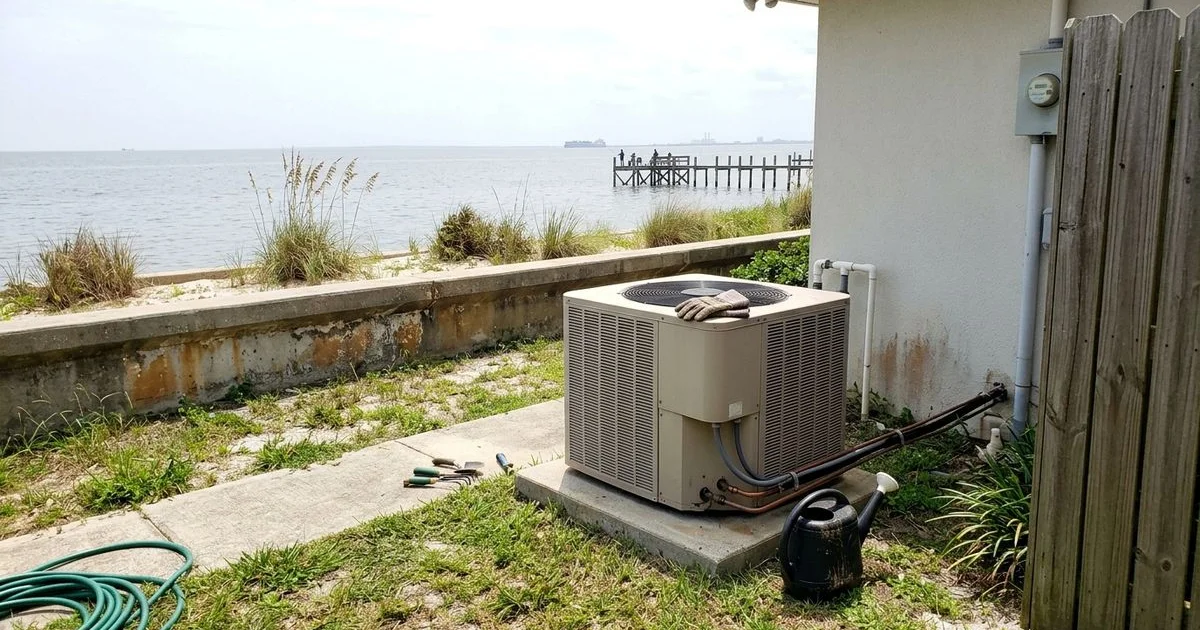
We know that salt air changes the basic rules of equipment survival near the coast.
The moisture rolling off Mobile Bay carries microscopic salt particles that settle directly on standard outdoor coils. A 30 percent loss in fin integrity can actually slash your system’s cooling capacity by up to 25 percent.
Our goal is to help you understand why these standard units can develop severe pitting and refrigerant leaks in just a few years.
You have to consider if AC replacement with a coastal ac condenser is the smarter long-term investment. Let’s examine the data on coastal corrosion, look at the specific coatings available, and determine if paying the premium makes sense for your property.
Why Salt Air Changes the Buying Decision
We explain to homeowners that salt air accelerates a destructive chemical reaction between the metals inside an air conditioner. Standard outdoor coils pair thin aluminum fins with copper tubes.
Our research shows this combination creates the perfect conditions for galvanic corrosion. Salt fog from the bay acts as an electrolyte when it bridges the gap between these two dissimilar metals.
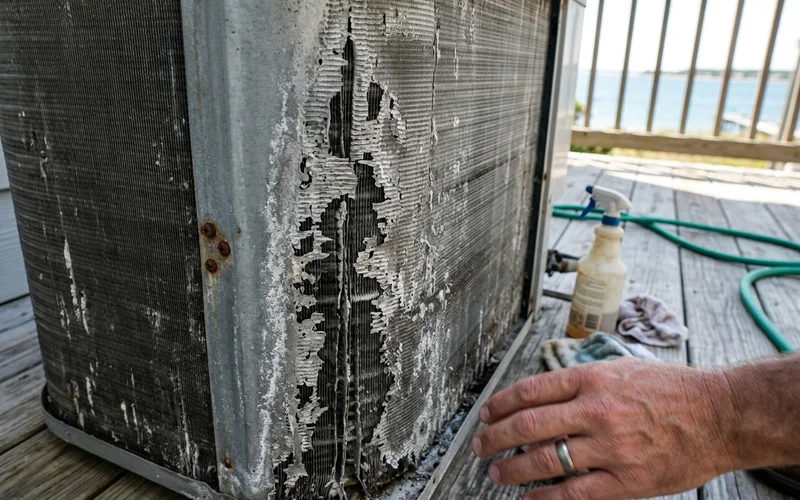
We often point out that the weaker aluminum fins act like a tiny battery and corrode to protect the copper. The fins flake, the copper tubes pit, and eventually the unit loses its refrigerant charge.
Our analysis of coastal data indicates unprotected aluminum fins in high-salt environments can begin pitting within just 24 to 36 months. A degraded coil forces the compressor to work harder, which spikes your energy bills before the system completely fails.
What “Coastal-Rated” Usually Means
We define a coastal-rated unit as an air conditioner built with specialized materials or factory-applied polymer coatings designed to resist salt damage. Manufacturers use different marketing terms, but true coastal protection involves specific engineering changes.
Our review of current equipment shows these upgrades usually include one or more of the following features.
- Factory-coated coils: Units often feature advanced treatments like ElectroFin E-Coat, a cathodic epoxy coating that passes 15,000 hours of ASTM B-117 salt spray testing.
- All-aluminum coils: Micro-channel heat exchangers use tubes and fins made of the identical metal, which completely eliminates the copper-aluminum galvanic reaction.
- Upgraded cabinets: You will find corrosion-resistant base pans and specialized marine-grade fasteners.
- Coated electrical parts: Premium units apply clear protective films over circuit boards and contactors.
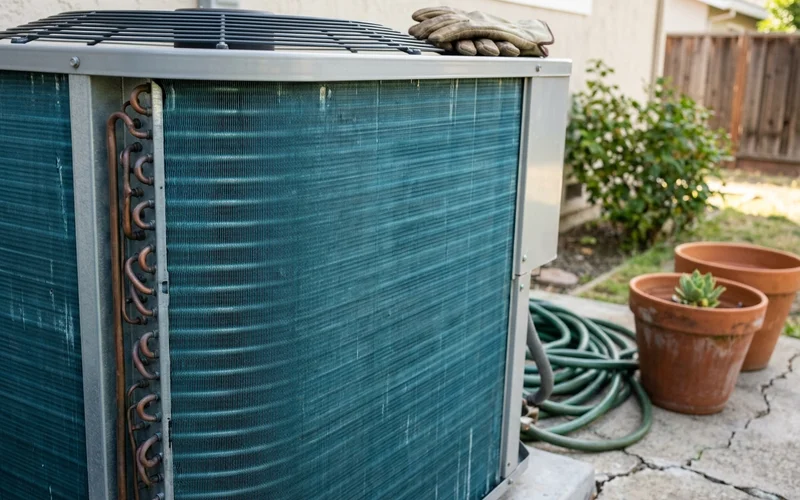
We always advise checking exactly what protection a quoted unit includes. The word “coastal” in a brochure might mean a heavy-duty polyurethane finish like Bronz-Glow, or it might just refer to a slightly better paint job on the exterior box.
Standard vs Coated: Side by Side
We compare standard and corrosion resistant ac units by looking directly at the numbers for upfront cost versus expected lifespan. A standard condenser replacement averages around $2,900 nationally, but unprotected units near the bay often fail in half their normal lifespan.
Our cost analysis shows that adding a factory coated condenser coil might increase the unit’s price by a small percentage, but it prevents a premature total system failure.
| Feature | Standard coil | Coated or coastal-rated |
|---|---|---|
| Upfront cost | Baseline average of $2,900 | Slightly higher initial premium |
| Salt resistance | Fins can pit within 24 to 36 months near the water | Passes 15,000-hour salt spray tests |
| Lifespan near the bay | Often shortened to 7 or 8 years | Closer to normal 15-year expectation |
| Maintenance | Rinse and clean regularly | Still rinse, but far more forgiving |
| Best for | Inland homes | Waterfront, bluff and near-bay homes |
We remind homeowners that the cheapest unit on paper is rarely the most affordable option over a decade. The math heavily favors specialized equipment if your property sits directly in the path of salty sea breezes.
Which Eastern Shore Homes Benefit Most
We categorize the need for coastal protection based on your exact distance from the water and prevailing wind patterns. Salt spray concentration is heaviest within the first 3,000 feet of the shoreline.
Atmospheric studies show that accelerated salt corrosion can affect metal components up to five miles inland. The specific geography of Baldwin County breaks down into three basic risk zones.
- On the water or bluff (Point Clear waterfront, Fairhope bluff, Montrose bayside, Battles Wharf): A strong case exists for mandatory coastal protection.
- Within a mile or so of the bay: You will find this is worth pricing out, especially if your old unit showed early corrosion.
- Several miles inland (much of Malbis, Loxley, northern Spanish Fort): A standard unit with good maintenance is usually fine.
Our best advice is to examine the evidence on your old unit. If its coil is crusted and flaking after eight years, the new condenser will face the exact same harsh environment.
The Cost vs Lifespan Trade-off
We view the cost of a coastal-rated unit as a straightforward insurance policy against early equipment failure. A coated coil adds a premium to the upfront price, but it allows the system to reach a normal 15-year lifespan.
Replacing a standard air conditioner at year seven because of severe pitting means you pay roughly $6,000 to $10,000 for two installations in the time it should take to pay for one. The return on investment is extremely high for waterfront properties.
Our financial breakdown shows the math is weaker for inland homes in Loxley. Spending extra on a specialized coating does not make sense if salt is not the primary threat to your equipment.
Maintenance Still Matters
We stress that factory coatings slow down corrosion, but they do not stop it completely without your help. You must actively wash away the corrosive salt deposits that accumulate during the summer.
Our recommended maintenance routine includes these basic steps.
- Use a garden hose: Rinse the outdoor coil gently with fresh water every few weeks and immediately after severe storms.
- Skip the power washer: Avoid using high-pressure spray, as the intense force can bend delicate aluminum fins and strip away the protective finish.
- Schedule professional cleanings: Have a licensed professional clean the system yearly using non-acidic formulas that protect the factory seals.
Your local HVAC contractor can provide specific guidance, and our guide on salt air maintenance covers the exact steps.
Placement Helps Too
We evaluate condenser placement carefully. Where the outdoor unit sits directly affects how much salt spray it catches.
Smart positioning can dramatically reduce the daily chemical attack on your equipment. Local building codes often dictate some of these decisions, especially in flood-prone areas.
- The side of the house away from the water usually sees much less direct spray.
- Raised pads or stands keep the unit out of splash and flood water. FEMA elevation certificates in Baldwin County may require this depending on your specific Special Flood Hazard Area.
- Landscaping as a buffer. A hedge or fence between the unit and the bay can cut salt spray, provided you leave a few feet of clearance for airflow.
- Avoid tight corners where salty air swirls and settles.
We suggest asking the licensed contractors we connect you with whether moving your unit is practical during a replacement. Line set extensions and new electrical work add some initial cost, but a sheltered location extends the life of the entire system.
Warranty Details Near the Water
We encourage you to read the fine print, because standard manufacturer warranties often contain hidden exclusions for salt damage. Major brands like Carrier and Trane frequently write special warranty terms specifically for installations near salt water.
You must register your new equipment quickly to maximize your coverage. If you fail to register a standard unit within 60 to 90 days, a 10-year parts warranty usually drops immediately to just five years.
Our review of major brands indicates certain product lines require you to purchase a specific coastal model to maintain full coverage on the coast. Ask the contractor to confirm the warranty terms for your exact location and model before you sign the paperwork, and keep those documents safe.
Questions to Ask on a Quote
We provide a specific list of questions to ensure you get accurate information before signing a contract. A vague promise of coastal protection is not enough when spending over $8,000 on a full system replacement.
Make sure the licensed contractors we connect you with provide concrete answers to these exact points.
- What specific corrosion protection does this unit have, and does it pass ASTM B-117 salt spray testing?
- Does the manufacturer warranty explicitly cover salt damage for my address?
- Would you recommend an all-aluminum micro-channel coil based on my location?
- Can the concrete pad be raised to meet local Baldwin County flood elevation requirements?
We are ready to help when you need an expert opinion. Call (251) 850-5502 for a free replacement estimate from a local HVAC contractor who installs near the bay.