
We know how frustrating it is when your central air runs all afternoon but your master bedroom still feels stuffy.
Industry studies show that a typical house loses 20 to 30 percent of its conditioned air through duct gaps.
For homes with leaky ducts, high electric bills are simply a mathematical certainty.
Our focus is on helping homeowners across Daphne, Fairhope, and the Eastern Shore identify these hidden efficiency drains.
Let’s look at the data, see where these leaks typically hide, and walk through the exact steps your local HVAC contractor will use to fix them.
The Attic Problem
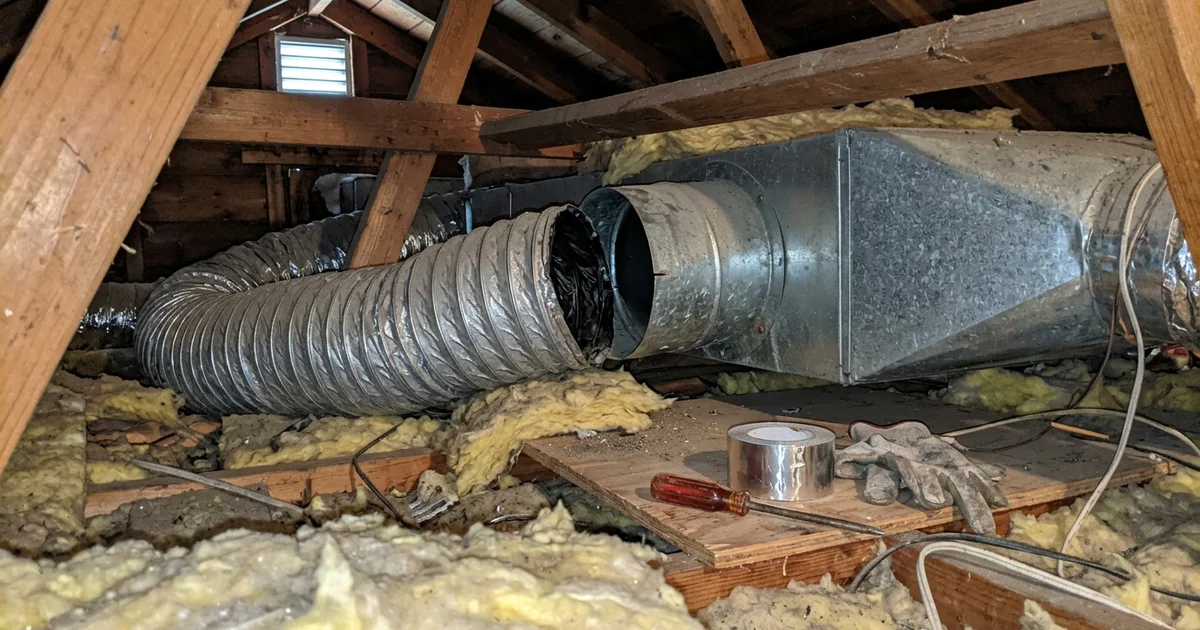
Most Eastern Shore homes run their ductwork straight through the unconditioned attic.
During an Alabama summer, those attics routinely reach 140 to 160 degrees Fahrenheit.
Every single leak in that ductwork either dumps your expensive, cooled air into that brutal heat or sucks hot humid attic air directly into your return system.
We see this exact scenario play out constantly across Spanish Fort and Malbis.
Studies of typical homes often find a significant share of airflow lost to these gaps.
You literally pay to cool air that never reaches your living room.
Our advice is to treat the ductwork as a primary suspect when comfort drops.
Sealing is a core part of duct sealing in Daphne and humidity control.
Three Ways Attic Heat Destroys Efficiency:
- Supply Leaks: Cooled air escapes into the attic before reaching your vents.
- Return Leaks: The system pulls 150-degree dusty air inside, forcing the AC to work harder.
- Thermal Transfer: Thin duct walls absorb radiant heat, warming the air inside the pipes.
Signs Your Ducts Leak
High bills, hot rooms, and a humid house are the most common indicators of duct leakage.
We often hear from homeowners who assume their aging air conditioner is the only reason for these issues.
The reality is that your equipment might be fine, but the delivery system is failing.
Here are the most common physical signs of leaky ductwork.
Comfort and Cost Symptoms:
- High summer bills compared with neighbors or past years.
- Hot or stuffy rooms, often the ones farthest from the air handler.
- Weak airflow from some vents.
- Extra dust on furniture, or dust streaks around supply vents.
Our network of local professionals always checks for secondary clues.
These visual and system-wide signs help confirm the diagnosis.
System and Equipment Signs:
- A humid, clammy house. Return leaks pull in wet attic air. See our guide on humidity problems.
- Crushed, kinked or disconnected flex ducts visible in the attic.
- The AC runs long hours but never quite catches up to the thermostat setting.
Where Ducts Usually Leak
Sheet metal connections and aging flex duct are usually the main culprits for air loss.
We know that finding every hidden gap in a dark attic is difficult.
Your contractor will check these notorious failure points first.
Common Leak Locations:
- Connections at the air handler, also known as the plenum.
- Joints between sheet metal duct sections.
- Where flex duct meets the metal boots at your ceiling vents.
- Return air boxes and filter grilles.
Our local HVAC partners frequently spot issues with older materials.
Old tape that has dried out and let go is a massive problem.
Flex ducts torn by pests or heavy foot traffic also create huge openings.
What a Duct Leakage Test Shows
We strongly recommend getting hard data before you pay for any major repairs.
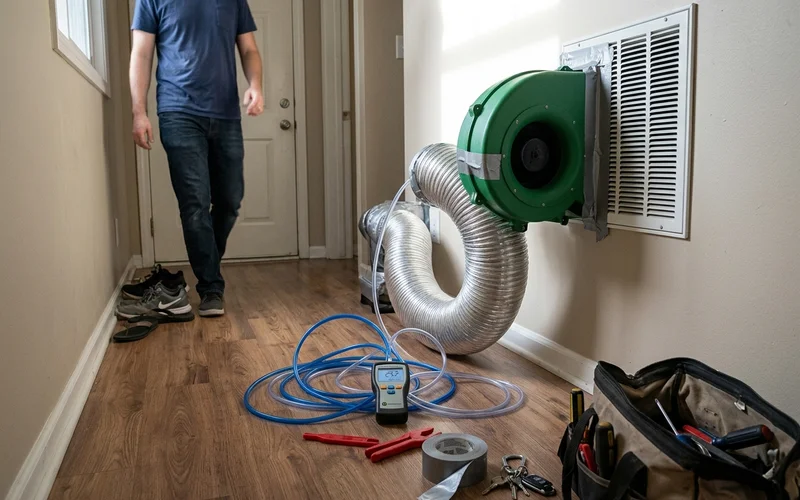
A licensed contractor seals your vents and connects a calibrated fan to the system.
This diagnostic tool pressurizes the ducts to measure exact airflow loss.
A gauge measures how much air escapes in cubic feet per minute.
The result tells you clearly whether sealing is worth the investment.
A retest afterward shows you exactly how much the service helped.
Our goal is always to ensure you see a measurable improvement.
Testing removes the guesswork from the entire process.
How Ducts Get Sealed
We see three primary methods used to fix attic air leaks: manual mastic sealing, aerosol injection, and physical replacement.
The right approach depends entirely on how accessible your ductwork is.
Your local HVAC contractor will likely recommend one of these proven solutions.
Traditional Manual Sealing
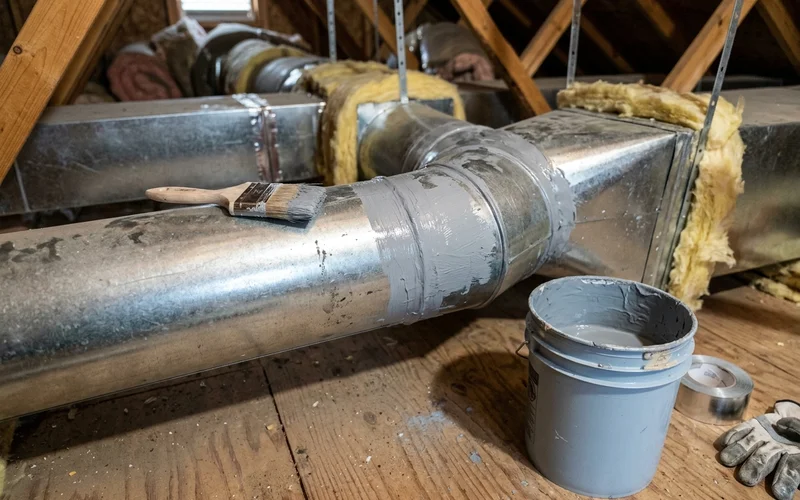
Mastic. A thick paste is brushed over joints, seams and connections that can be reached easily.
It stays flexible, handles temperature swings, and lasts for decades.
It is the standard for accessible attic ducts.
Foil tape. UL-listed foil tape works for some small joints.
Cloth “duct tape” does not work and will fail rapidly in attic heat.
Advanced Aerosol Technology
Our preferred solution for hidden gaps is a pressurized sealant.
Aerosol sealing. A vinyl polymer sealant is blown through the pressurized duct system from the inside.
It builds up at leaks until they close, reaching spots behind walls and under deep insulation.
Aeroseal is one well-known method, originally developed by the Department of Energy, and it can reduce leakage by up to 90 percent.
Physical Repairs
Repairs and replacement. Sometimes sealing is not enough to fix the damage.
Crushed or torn flex duct gets replaced entirely.
Disconnected runs get permanently reattached and strapped securely to the framing.
| Method | Best for |
|---|---|
| Mastic | Accessible attic joints and connections |
| Foil tape | Small joints, temporary patches |
| Aerosol | Hidden or hard-to-reach leaks, whole system |
| Replacement | Crushed, torn or badly sized ducts |
Ducts in Older Eastern Shore Homes
Older homes in Daphne, Fairhope and Montrose often have ductwork that has been added to and patched over many years.
Common findings include cloth tape that fell off long ago and flex duct crushed by storage or foot traffic.
Returns built from the house framing itself, known as panned returns, leak heavily because wood framing is not airtight.
Ducts are often found completely disconnected during past roof or attic work.
These older homes often see the biggest improvement in comfort from professional sealing.
Newer properties are definitely not immune to these issues either.
Our partner contractors often find builder installations with poorly sealed boots at the ceiling vents.
Long, sagging flex runs that restrict airflow are another common issue in new construction.
Fixing these restrictions allows the system to push air efficiently into your living space.
Beyond Sealing: Insulation and Layout
Sealing stops direct air leaks, but ducts in a hot attic still gain heat through their thin walls.
Make sure all your ducts are properly insulated.
Industry standards now suggest an insulation rating of R-8 for attic ductwork to block out that 150-degree heat.
We always recommend evaluating the entire system setup.
Some simple upgrades make a massive difference in how hard your AC works.
Smart System Upgrades:
- Shorter Runs: Ask your contractor if any long flex runs can be shortened or rerouted.
- Radiant Barriers: Install foil barriers to reflect solar heat away from the attic space.
- Upgraded Insulation: Blow in more attic insulation to lower temperatures across the whole area.
Our advice is to address these layout issues before buying new equipment.
If you are planning an AC replacement, it is the ideal time to fix duct problems.
The contractor can size the new equipment accurately to match the improved, airtight ducts.
Is It Worth It?
In a hot, humid climate with attic ducts, sealing often pays back through lower bills, more even temperatures and better humidity control.
The Department of Energy notes that fixing these leaks can improve HVAC efficiency by up to 20 percent.
The initial diagnostic duct test makes the final decision clear.
We know that taking the next step feels like a big commitment.
A licensed, insured contractor can test your ducts and give you a free estimate on sealing.
Call (251) 850-5502 to get connected with a local professional today.